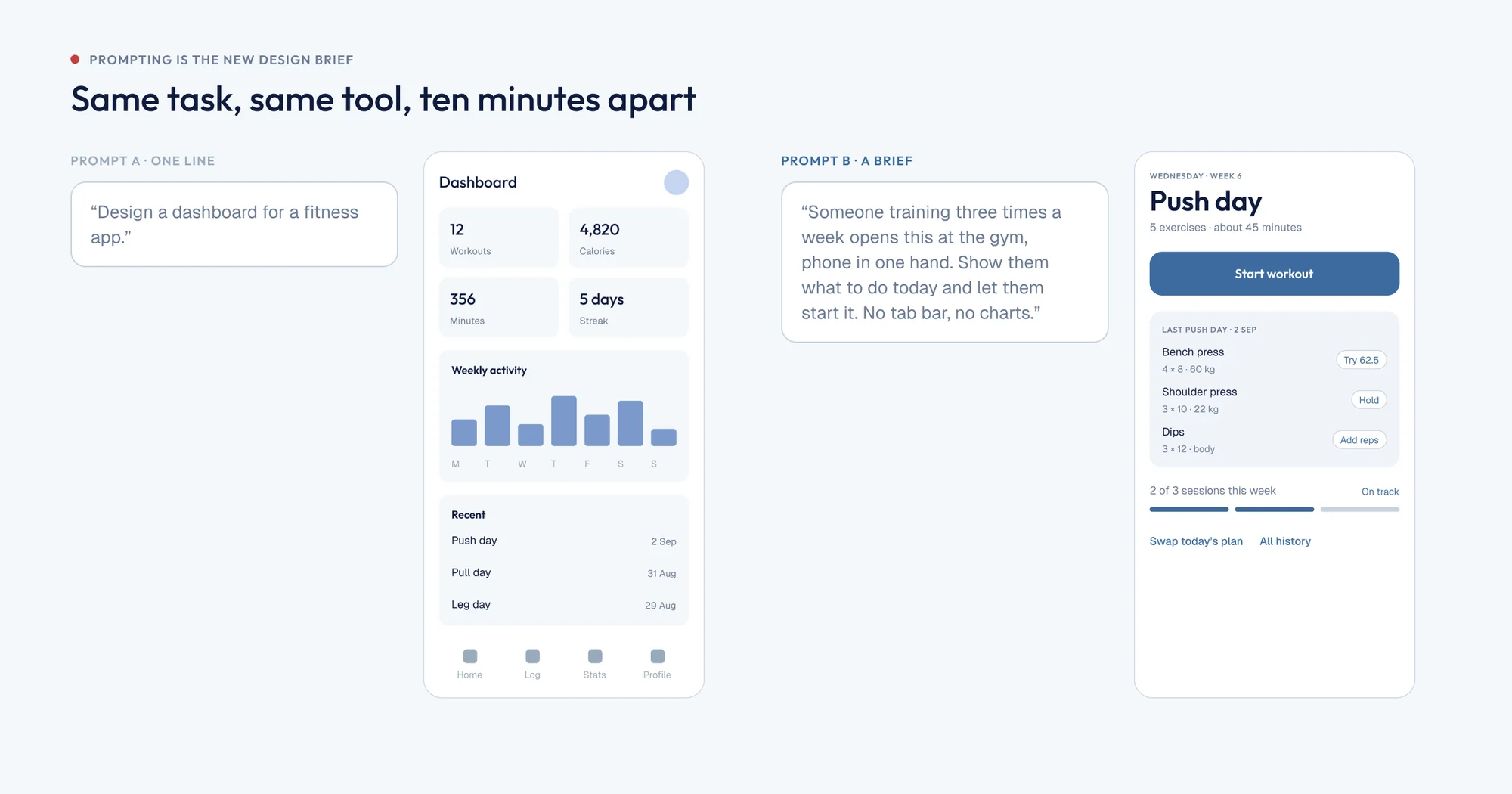
Designers keep asking me how to get better at prompting. My honest answer is that you already know how. A prompt is a brief, and you have been writing briefs for years.
The difference is that a bad brief wastes a week and a bad prompt wastes ten seconds, so people never learn to write a good one. They just try again.
Same task, two prompts
Ask for "a dashboard for a fitness app" and you get the average of every dashboard on the internet: four stat cards, a line chart, a calendar. Ask for the same screen with the user, the moment and the constraint attached, and you get something you can actually argue with.
The five parts of a brief-style prompt
- Context. What the product is and who it is for.
- The user and the moment. Who opens this screen, and what happened just before.
- Constraints. Platform, existing components, and other assets.
- Success criteria. How you will know the output is good.
- Anti-goals. What you specifically do not want.
A vague prompt gets you the average of the internet. A brief gets you a decision.
Constraints are where the design happens
The anti-goals do more work than anything else. "No carousel, no modal, everything reachable in one thumb" produces a different design than the same request without those lines, and the difference is judgment you supplied.
Iterate like a critic, not a slot machine
When the output is wrong, most people re-roll. Better to do what you would as a critic: name what is wrong and why, then ask for a specific change. "The hierarchy is flat because everything is the same weight – make the primary action the only bold element" gets you somewhere. Pressing regenerate does not.